I finally watched the most recent Ken Burns series on the American Revolution (PBS). Unsurprisingly, I loved it. The many quotes he had from people, especially those from often-overlooked groups, evoked all the emotions that are rising the closer we get to America’s 250th birthday. The series portrays the American Revolution as it was at the time: a civil war, pitting British citizens against each other, in an audacious struggle for freedom from European tradition. It dealt unapologetically with the dichotomies of the Revolutionary period that are often glossed over in our history classes. The American struggle for freedom while slavery flourished. The right to land while Native Americans were dispossessed. The extreme violence Patriots perpetrated against those who did not join the cause. History is never neat, and we would do a disservice to our ancestors who lived through it by treating it as such.
The series inspired me to take a break from DNA clustering to look more deeply into one of my own Patriot Ancestors.
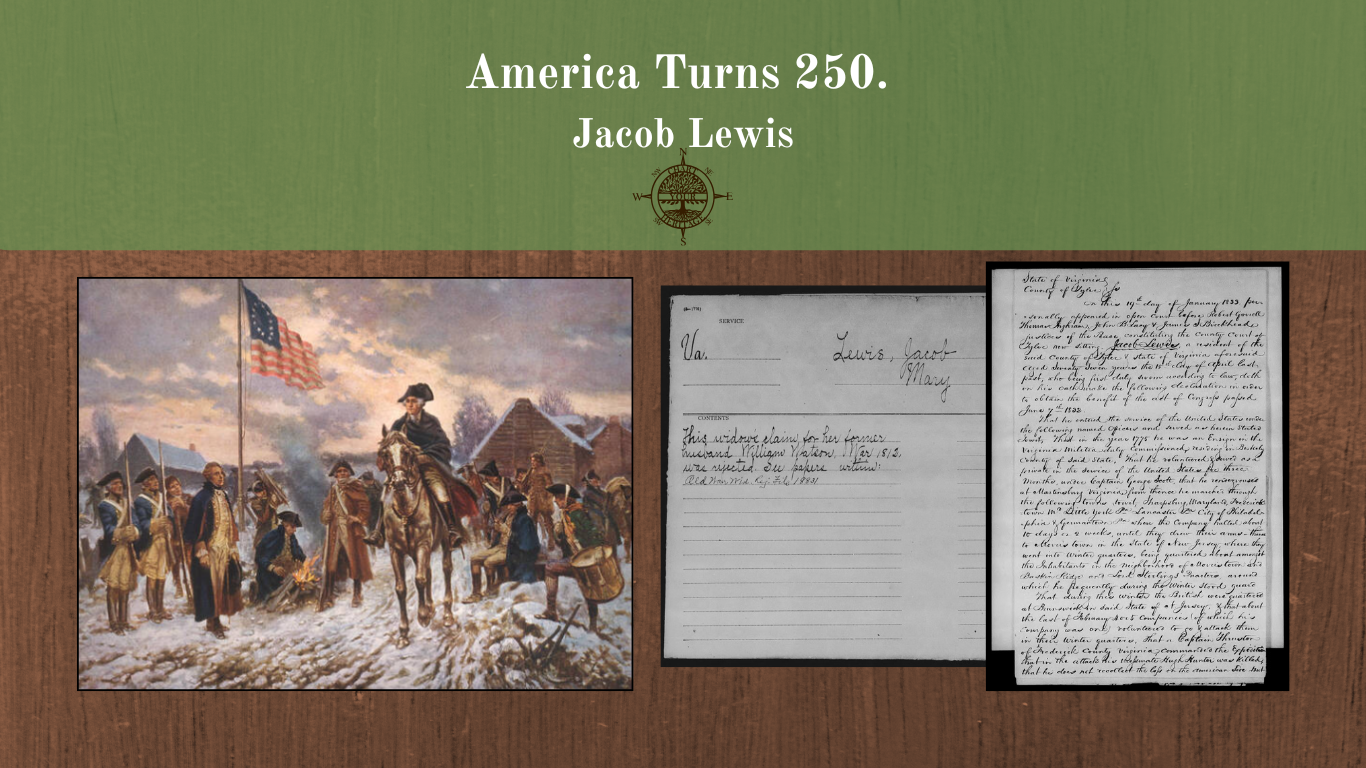
As an Ensign in the Virginia Militia, living in Berkeley County, Virginia, Jacob Lewis volunteered to serve as a private in the Continental Army of the United States. He served under Captain George Scott during his first campaign in the Army.
In Jacob’s deposition for his pension he gave the year 1775. However, cross-referencing other pensioners of Captain George Scott’s company, and the known fact that the Continental Army wintered in Morristown, New Jersey, in the winter of 1776-77, it is likely he is off one year. Jacob likely served in the Continental Army in the winter of 1776-1777. Jacob gave his deposition on 19 January 1833 in Tyler County, Virginia when he was 77 years old, and fifty-six years after his first service in the Continental Army. It is understandable his memory may not have been perfect.
John Sharp of Berkeley County, another pensioner serving under Captain George Scott, stated that they marched from Martinsburg on 20 January 1777. In John’s pension application he provides the same route that Jacob gave, indicating the two men likely served together at this time.
“…we marched on to Philadelphia we made no halt there on account of the smallpox being very bad…”
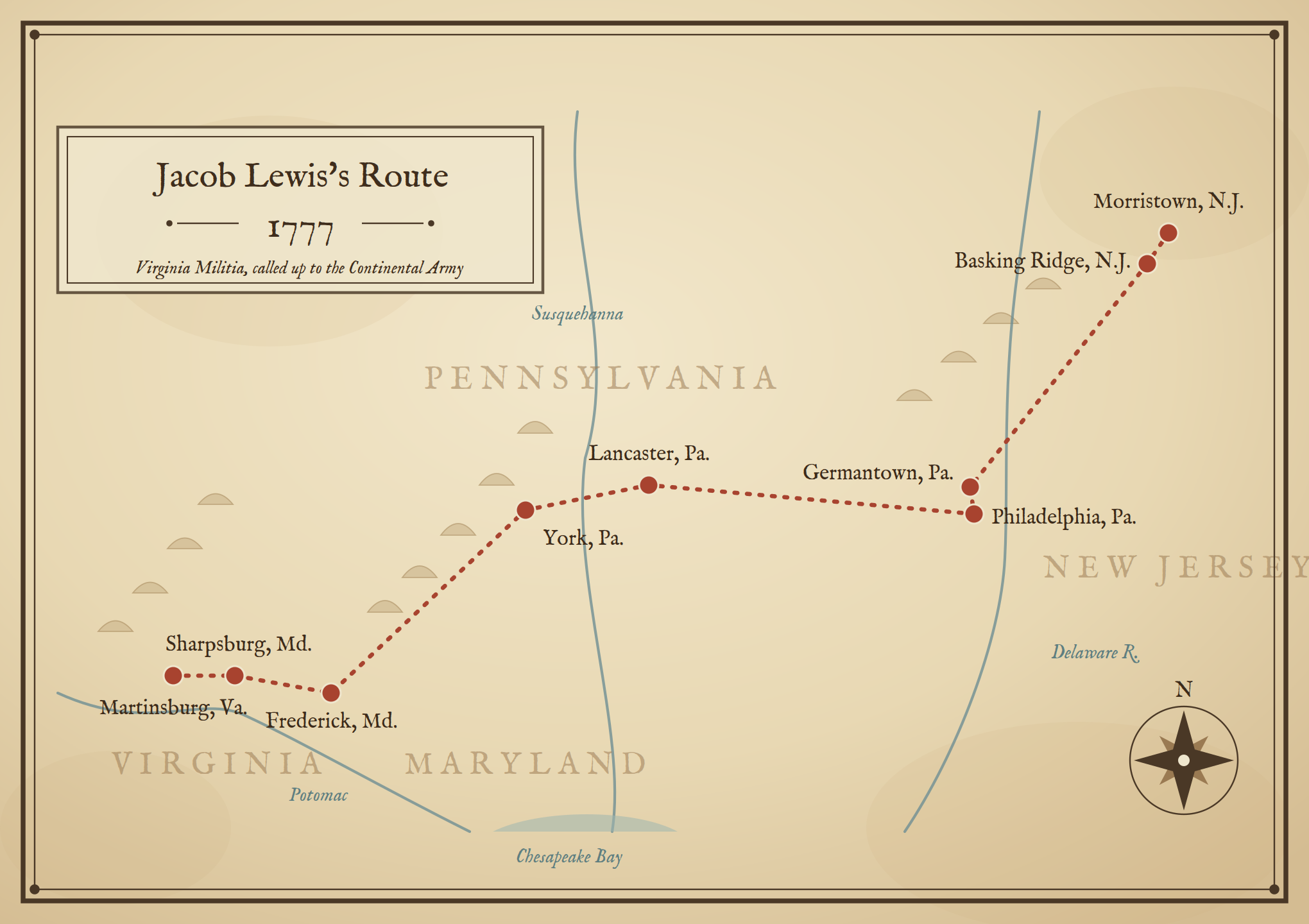
Map created using Claude Opus 4.8
General Washington had refused to inoculate his Army in the winter of 1775-76 for fear that it would place them in a position of vulnerability; however, by the following winter he realized smallpox could defeat his army. On 6 February 1777 he ordered the entire Continental Army inoculated. As Jacob Lewis was serving in the Continental Army at this time it is likely he received an inoculation, if he hadn’t previously contracted the disease. It is a monumental feeling when you realize an ancestor was part of something that could determine his fate. What if Washington hadn’t ordered the inoculation? Jacob could have contracted a deadly form of the smallpox and never gone on to have Sarah, his daughter and my 5th-great-grandmother!
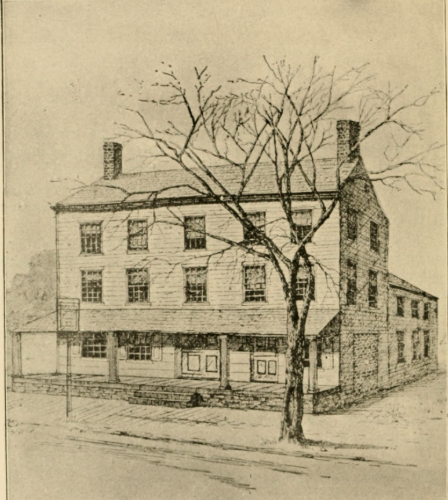
Arnold’s Tavern, Morristown, New Jersey
Washington’s Headquarters during the winter of 1777
According to John Sharp’s pension application, the company was discharged on 1 April 1777. Jacob stated he was discharged at Basking Ridge, New Jersey after serving five months.
After this discharge, while he was still an Ensign in the Virginia Militia, Jacob was again detailed to the Continental Army, this time to serve under Captain James Buckels from Berkeley County. After mustering at Martinsburg, Virginia, the Company marched to Fort Pitt (Pittsburgh) and then to “what was called Raritan Bottom Fort on the Ohio River, below Fort Pitt.” According to Jacob, they stayed there for three months, then he was discharged and returned home.
Only three weeks later, according to Jacob, Berkeley County instituted a draft. Jacob substituted for William Blamson and returned to duty in the Continental Army.
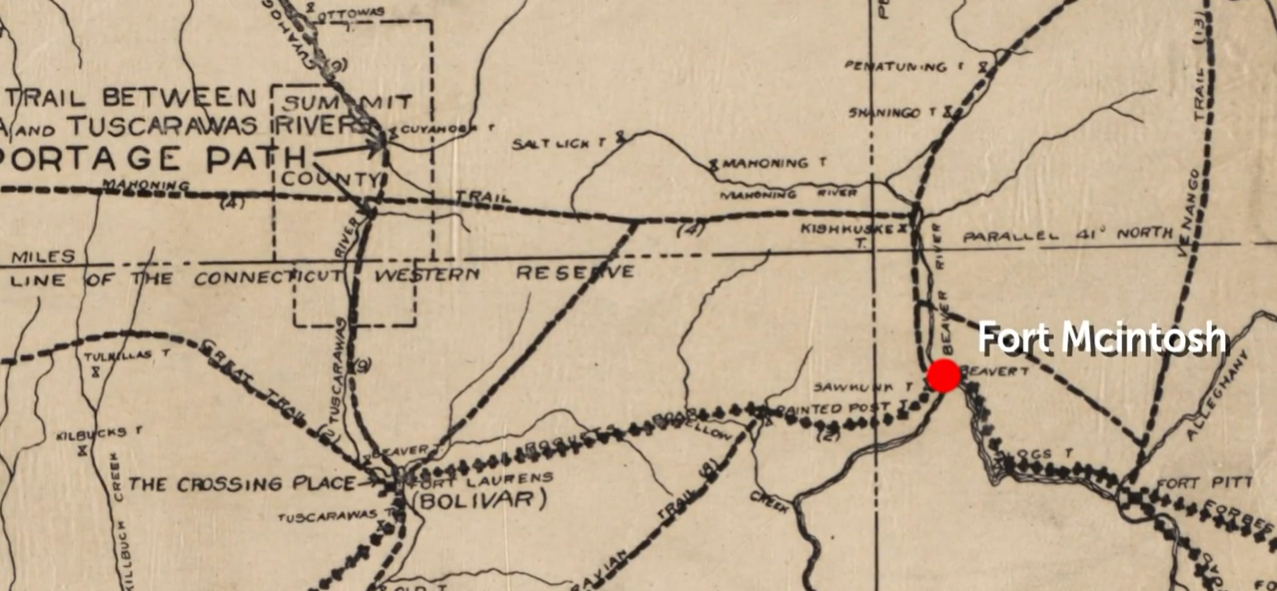
Serving under Captain Ambrose and Lieutenant Colonel John Morrow, Jacob returned to Western Pennsylvania, this time Fort McIntosh at the mouth of the Big Beaver River.
Construction of Fort McIntosh, located where the Beaver River empties into the Ohio River 33 miles northwest of Fort Pitt, was directed in 1778. It is likely that more time than three weeks elapsed between Jacob’s discharge in the fall of 1777 and his substitution. He likely reported to Fort McIntosh in the fall of 1778.
After arriving at Fort McIntosh, Jacob was part of the effort to build a fort in the Northwest Territory (now Ohio) as an advance outpost from which the Americans could attack the British-held Fort Detroit. They erected Fort Laurens (named for the then President of the Continental Congress) on the Tuscarawas, a branch of the Muskingum River.
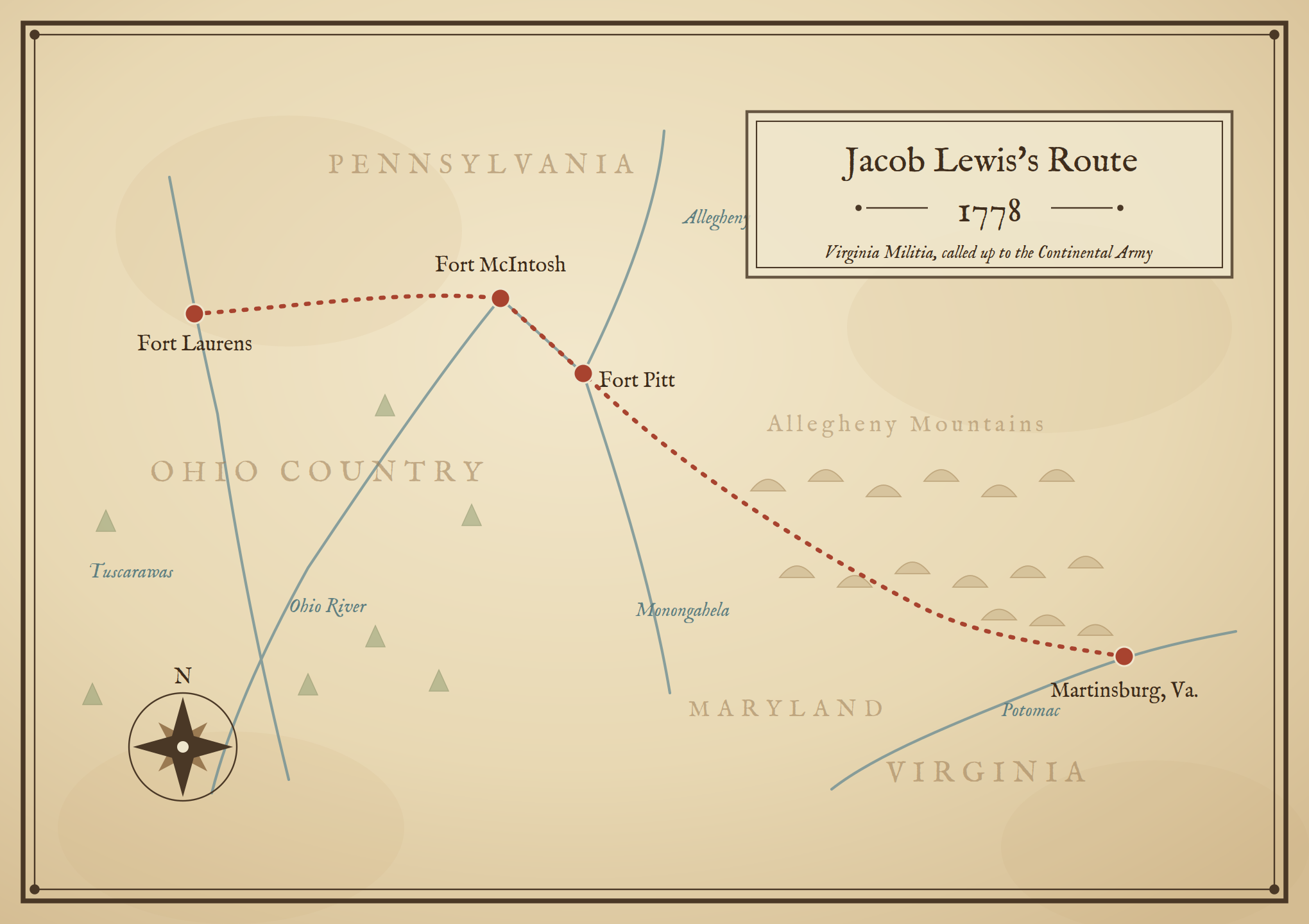
Map created using Claude Opus 4.8
Fort Laurens had a short history in the American Revolution. However, as I dug into its history, darker parts of the Revolution emerged, showing even this small corner was not free from the cruelty of the time. Prior to General McIntosh's expedition to build Fort Laurens, Colonel (later promoted to General) Hand had led an expeditionary force of local militia up the Beaver River and massacred a camp of peaceful Delawares, a neutral Native American tribe.
The soldiers building Fort Laurens felled the logs in a wide arc around the future fort and made do with a shortage of nails and other building supplies. Working in October-December Ohio weather was likely difficult—dropping temperatures, snow, and sleet. In December General McIntosh returned to his namesake fort, leaving only a small contingent to man Fort Laurens through the winter. The contingent left at the fort was poorly provisioned, resulting in harsh conditions and starvation. The British and their Native American allies also ambushed a group of soldiers while they were outside the safety of the fort’s walls, killing all of them.
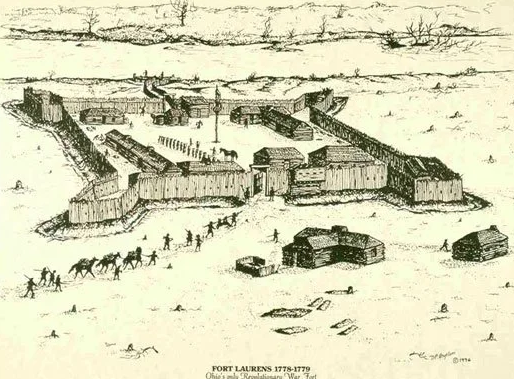
Fort Laurens 1778-1779
For more information on Fort Laurens, I highly recommend the PBS video https://www.pbs.org/video/fort-laurens-njb37y/.
Jacob doesn’t mention any of this in his straightforward deposition. He was likely part of the larger force which returned to Fort McIntosh in December 1778 and likely didn’t suffer the deprivations the small force left at Fort Laurens labored under that winter.
At the close of his deposition Jacob admits, “in the foregoing declaration he may be mistaken as to the precise year the service was performed in, which is only stated to the best of his recollection, but in the service itself he has a pretty positive recollection.”
He also mentions that during his first campaign he “was acquainted with General Washington.” Whether he actually met the General is not certain, but he certainly would have been in the same camp.
Like so many other Revolutionary War veterans, Jacob headed West after the creation of the United States. He resided for a time in Uniontown, Pennsylvania, before moving into Greene County, Pennsylvania, then south, along the Ohio River, to Tyler County, Virginia where he died in 1840. His daughter, Sarah, remained in Tyler County.
I joined the DAR, many years ago, using another Patriot Ancestor. I have since found several more in my tree. Jacob’s story isn’t the most sensational of these ancestors (one escaped a British prison after capture on Long Island) but for some reason I have always felt drawn to his story. Maybe it was his westward push that inspired me, or the matter-of-fact tone of his deposition. Diving into his story, mapping his service, cross-referencing his recollections with historical timelines, have given me an even greater connection to him, and an appreciation for his service. I believe we share the same sense of service, patriotism, and commitment to the ideals of the American Revolution, that all men are created equal. This Fourth of July, I will be toasting my 6th-great-grandfather Jacob Lewis.